

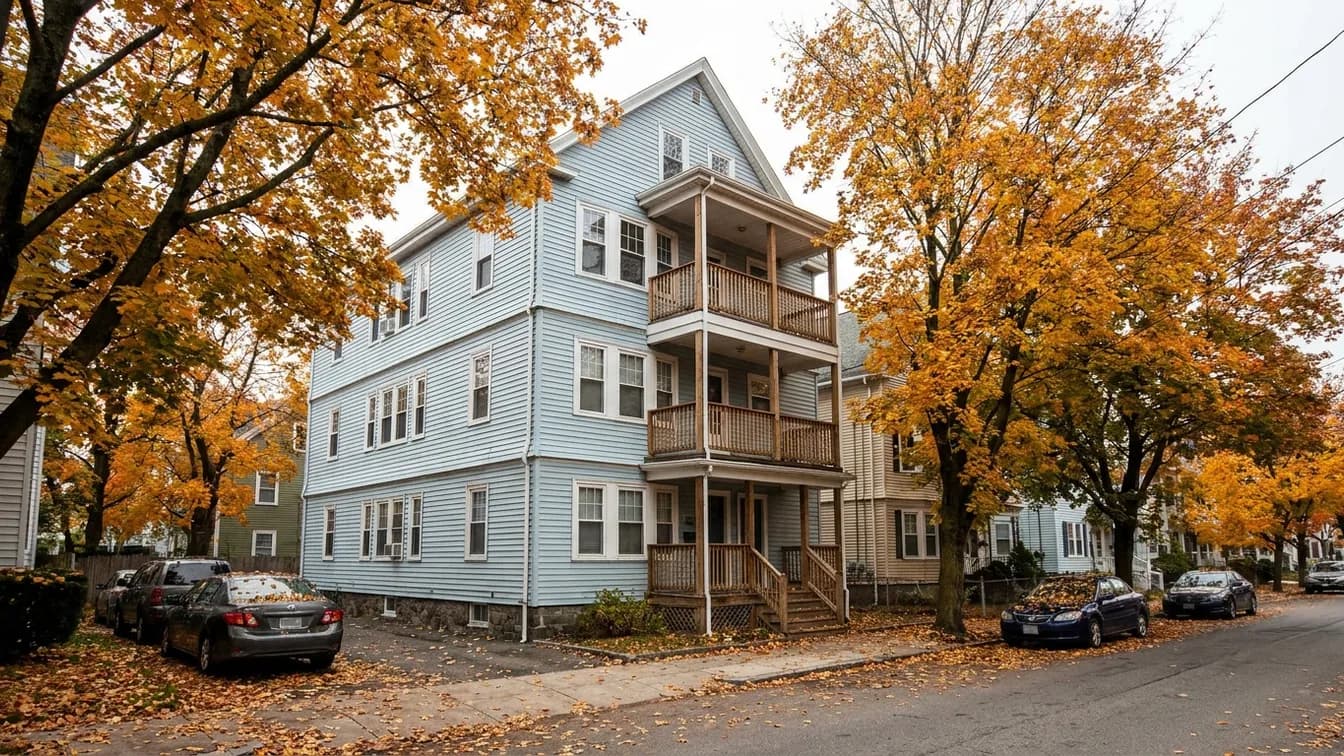
Living in one unit of a two-family or triple-decker lets tenants' rent help cover the mortgage, but lenders apply stricter rules to multi-unit homes than to single-family ones.
Owner-occupied loan options differ on down payment, 75% projected rent credits, the FHA self-sufficiency test for three- and four-family homes, and 2026 county loan limits.
Check Your Massachusetts Home Purchase Eligibility
Select the loan that fits a specific building and know which numbers to run before making an offer.
Can You Buy a 2–4 Unit Home With a Small Down Payment?
Yes, if you live in one of the units. A building with two, three, or four separate legal units is still financed with a residential mortgage rather than a commercial loan, so moving into one apartment as your primary residence opens owner-occupied programs with low down payments and higher multi-unit loan limits.
If you plan to rent out every unit and live elsewhere, owner-occupied loans are off the table and you will need an investment property loan or a DSCR loan in Massachusetts with a much larger down payment.
| Loan | Units | Minimum down (you live there) | Credit score | Mortgage insurance | Key rule |
|---|---|---|---|---|---|
| FHA | 2–4 | 3.5% (580+ score); 10% (500–579) | 580 for 3.5% down | 1.75% upfront plus 0.55% or 0.75% a year | 3 months of reserves and self-sufficiency test on 3–4 units |
| Conventional (Fannie Mae) | 2–4 | As low as 5% within standard limits | Set by lender | PMI under 20% down | Automated underwriting only; no high-balance loans at 5% down |
| VA | 2–4 | 0% | Set by lender | None (funding fee may apply) | Eligible veterans and service members |
| MassHousing | 2–4 | 3.5% on FHA; 3% of your own funds on conventional | Set by program | FHA premium or MassHousing MI | Landlord counseling before closing |
| ONE Mortgage | 2–3 | 3% (2-unit); 5% (3-unit) | 660 | No PMI | First-time buyers; income and asset limits; landlord course |
We are a mortgage broker that compares FHA, conventional, VA, and investor loans across multiple wholesale lenders. MassHousing and ONE Mortgage loans are offered only through their respective participating lenders, and our team can help you check eligibility, compare loan options side by side, and get pre-approved.
FHA Loans: 3.5% Down on Up to Four Units
An FHA loan in Massachusetts is popular for triple-deckers because the minimum down payment does not rise as you add units. FHA single-family programs cover 1–4 unit owner-occupied principal residences under these core rules:
- Down payment and credit: You need 3.5% down (96.5% loan-to-value, or LTV) with a credit score of 580 or higher, or 10% down with a score between 500 and 579.
- Occupancy: At least one borrower on the loan must move into one of the units within 60 days of closing and intend to live there as a principal residence for at least one year.
- Mortgage insurance: FHA charges 1.75% upfront (usually financed); on a typical 30-year loan with 3.5% down, annual MIP is 0.55% on base loans up to $726,200 and 0.75% above $726,200.
- Reserves on 3–4 units: On a three- or four-family home, you need cash reserves equal to at least three months of PITI (principal, interest, taxes, and insurance) left after your down payment and closing costs.
A single-family home with one accessory dwelling unit (ADU), such as an in-law apartment, is still treated as a one-unit property under FHA rules, and any ADU rent counted as income cannot exceed 30% of your total effective income.
The Self-Sufficiency Test for Three- and Four-Family Homes
If you use an FHA loan, two-family homes don't have to pass this test, while three-family and four-family properties must pass or they are ineligible for FHA financing at that loan amount.
Your total monthly PITI cannot exceed the building's net self-sufficiency rental income: the appraiser's fair market rent for all units (including yours) minus the greater of 25% or the appraiser's vacancy and maintenance estimate.
In plain terms, conservative rent from the whole building must cover the whole monthly mortgage payment on paper.
| Step | Calculation | Amount |
|---|---|---|
| Market rent, all 3 units | $2,400 x 3 | $7,200 a month |
| Minus 25% vacancy and maintenance | $7,200 x 25% | -$1,800 |
| Net self-sufficiency rent | $7,200 - $1,800 | $5,400 |
| Maximum PITI allowed | Can't exceed the line above | $5,400 |
If your projected monthly PITI comes out to $5,250, the triple-decker passes. If your PITI is $5,700, the loan fails at 3.5% down, so you would need a larger down payment to bring the payment down to $5,400 or less, a lower purchase price, or a conventional loan, which does not use a self-sufficiency test.
Check Your Massachusetts Multifamily Eligibility and Run the Numbers
Conventional Loans: 5% Down Through Fannie Mae
Fannie Mae now allows as little as 5% down (95% LTV) on many 2–4 unit primary residence purchases, down from the old requirements of 15% on a two-family and 25% on a three- or four-family home.
Because conventional loans skip the FHA self-sufficiency test, a 5%-down conventional loan can work on a triple-decker where high prices and taxes cause an FHA loan to fail.
Confirm two major guardrails with your lender before counting on 5% down:
- Standard limits only: The 5%-down rule applies only to standard conforming loan amounts, not high-balance loans above the 2026 baseline ($1,066,250 for a 2-unit, $1,288,800 for a 3-unit, or $1,601,750 for a 4-unit) up to a high-cost county ceiling.
- Automated underwriting only: The loan must be approved through Fannie Mae's automated underwriting system (manual underwrites are excluded), where the maximum total debt-to-income (DTI) ratio is 50%.
If you negotiate seller concessions toward your closing costs on a Fannie Mae principal residence purchase, the cap depends on your LTV and is based on the lower of the sales price or appraised value:
- 3% if your LTV is over 90% (less than 10% down)
- 6% if your LTV is 75.01% to 90%
- 9% if your LTV is 75% or less
How Lenders Count the Tenants' Rent
Both FHA and Fannie Mae let you count projected rent from the units you will not live in (never from your own unit), even with no prior rental history, using the appraiser's rent estimates. Both programs apply a 25% vacancy and maintenance factor, so they count 75% of the gross monthly rent from the tenant units.
Suppose two tenant apartments are estimated to rent for $2,400 a month each, or $4,800 total; the lender counts 75% of that, which is $3,600 a month. The big difference is how that $3,600 enters your debt-to-income ratio under each program.
| Rule | FHA | Conventional (Fannie Mae) |
|---|---|---|
| Rent counted | 75% of the lesser of market rent or a signed lease | 75% of gross rent from the appraisal (or a lease that transfers at closing) |
| How it enters your DTI | Added to your gross monthly income | Subtracted from the property's full PITIA to get adjusted net rental income; a shortfall is added to your monthly debts |
| Landlord experience | Not a factor | A positive result counts as income only with 12+ months of property management experience; otherwise it only offsets the payment |
If you already have a rental history on the property, FHA uses your last two years of tax returns (including Schedule E) instead of the appraisal estimate, and on conventional loans the lender must also document your current housing payment.
Because offsetting the new mortgage payment directly changes your DTI ratio differently than adding rent to your gross income, compare both calculations side by side during pre-approval.
2026 Loan Limits for 2–4 Unit Homes
Multi-unit homes qualify for higher maximum loan amounts because they house more households. In the five Greater Boston counties and on the Islands, FHA and conforming limits match; in the rest of Massachusetts, conforming limits are higher than FHA limits.
Loan limits update every year (as of October 28, 2026, 2027 limits have not yet been announced), so confirm the current figures with your lender when you apply.
| County | Loan type | 2-unit | 3-unit | 4-unit |
|---|---|---|---|---|
| Essex, Middlesex, Norfolk, Plymouth, Suffolk | FHA and conforming | $1,232,250 | $1,489,500 | $1,851,100 |
| Dukes, Nantucket | FHA and conforming | $1,599,375 | $1,933,200 | $2,402,625 |
| Barnstable | FHA | $1,060,000 | $1,281,300 | $1,592,350 |
| Bristol | FHA | $1,008,450 | $1,219,000 | $1,514,950 |
| Worcester | FHA | $697,800 | $843,500 | $1,048,300 |
| Berkshire, Franklin, Hampden, Hampshire | FHA | $693,050 | $837,700 | $1,041,125 |
| Barnstable, Berkshire, Bristol, Franklin, Hampden, Hampshire, Worcester | Conforming | $1,066,250 | $1,288,800 | $1,601,750 |
For single-family figures and how baseline versus high-balance tiers work, see our guides to FHA loan limits in Massachusetts and conforming loan limits in Massachusetts.
Notice the gap in Worcester County: the 2026 FHA limit for a 3-unit triple-decker is $843,500, while the conforming limit is $1,288,800. Because $1,288,800 is the standard baseline 3-unit limit rather than a high-balance ceiling, a qualified buyer in Worcester County can pair that higher limit with Fannie Mae's 5%-down rule.
Check Your Massachusetts Home Purchase Eligibility
VA, MassHousing and ONE Mortgage
Veterans and income-eligible Massachusetts buyers have three additional paths to finance a 2–4 unit primary residence.
VA Loans
Eligible veterans, active-duty service members, and surviving spouses can use a VA purchase loan to buy up to 4 units if the veteran lives in one unit as a primary residence. No down payment is required when the purchase price does not exceed the appraised value, and VA loans never charge monthly mortgage insurance.
Veterans with full entitlement have no VA loan limit; instead, the lender sets the maximum loan based on your credit, income, debts, and assets. See how a VA loan pairs with state programs in our guide to Massachusetts veterans homebuyer benefits.
MassHousing
Through MassHousing-approved lenders, buyers can finance a 2–4 family primary residence as long as at least one borrower signing the note completes a landlord counseling course with an approved agency before closing.
On conventional MassHousing 2–4 unit loans, 75% of projected rents count toward compliance income, and you must contribute at least 3% from your own funds (compared to no required borrower contribution on a 1-unit home).
MassHousing's FHA options allow up to 96.5% LTV (3.5% down) on 1–4 units. Read our MassHousing mortgage guide for income limits and down payment assistance, and remember you must apply through a participating MassHousing lender.
ONE Mortgage
Offered by the Massachusetts Housing Partnership through participating lenders, the ONE Mortgage program serves first-time buyers (no homeownership in the last three years) within program income and asset limits, including countable assets under $100,000. Confirm current income and purchase price limits with a participating lender.
Under ONE Mortgage rules, four-family homes aren't eligible, so the program covers single-family homes, condos, two-family homes, and three-family homes.
You need at least a 660 credit score on a two- or three-family purchase (compared to 640 on a single-family or condo), and ONE Mortgage never charges private mortgage insurance even at 3% or 5% down.
Buyers of two- or three-family homes must complete a landlord course or one-on-one counseling with an approved agency, and three-family buyers need one-on-one counseling before closing.
Not Living There? DSCR Loans for Investors
If you will not live in any of the units, the owner-occupied programs above are off the table. Many real estate investors use a Debt Service Coverage Ratio (DSCR) loan, which qualifies the property by dividing its monthly gross rents by its monthly PITIA rather than using your personal tax returns or W-2 debt-to-income ratio.
Terms vary across wholesale lenders, but on one wholesale lender's current 2026 matrix for a 2–4 unit DSCR purchase, guidelines require:
- You certify that you will not occupy any unit
- Maximum 75% LTV (at least 25% down) on a 2–4 unit purchase
- Minimum DSCR above 1.00, meaning rents exceed the total monthly PITIA
- Minimum 680 credit score and 6 months of PITIA reserves
For a full breakdown of how investor cash-flow underwriting works, see our DSCR loan guide for Massachusetts.
Landlord Rules and Tax Breaks
You become a Massachusetts landlord the day you close on a two-family or triple-decker, so factor two state and local rules into your budget from the start:
- Lead paint law: When a child under six lives in a pre-1978 rental unit with dangerous lead in paint, plaster, or other accessible material, the owner must abate or contain the hazard. Owners cannot refuse to rent to or evict families with children because of lead paint.
- Residential exemption: Massachusetts cities and towns can grant a local property tax exemption on a homeowner's principal residence. If you live in one unit in a town that adopts it, such as Boston (FY2026 exemption $4,353.74), you may qualify once the home is your domicile on record.
Read our guide to the Massachusetts lead paint law for details on inspections, compliance letters, and financial help, and ask your local assessor how any residential exemption applies to multi-unit parcels and when to file.
Next Steps
Before you make an offer on a two-family or triple-decker, run three checks on the building:
- Pull realistic market rent estimates for each unit so you know what 75% of the tenant rent looks like.
- If you are eyeing a three- or four-family home with FHA, run the self-sufficiency test against the full estimated PITI before you write an offer.
- Compare how FHA and conventional underwriting apply that rent to your debt-to-income ratio.
At Make Massachusetts Your Home, operated by Next Wave Mortgage, we compare FHA, conventional, VA, and DSCR options across multiple wholesale lenders so you can see how a specific property works on paper.
Checking your eligibility requires no hard credit pull, pre-approval typically takes 1 to 3 business days once your documents are in, and you can book a free 15-minute call with a loan officer to go over a building's rents.
Ready to Get Started?
Check your eligibility in under 2 minutes. No credit pull, no obligation.
Get our Massachusetts updates in your Google feed
Add Make Massachusetts Your Home as a preferred source to see our rate, grant, and program updates more often in Google Search.