

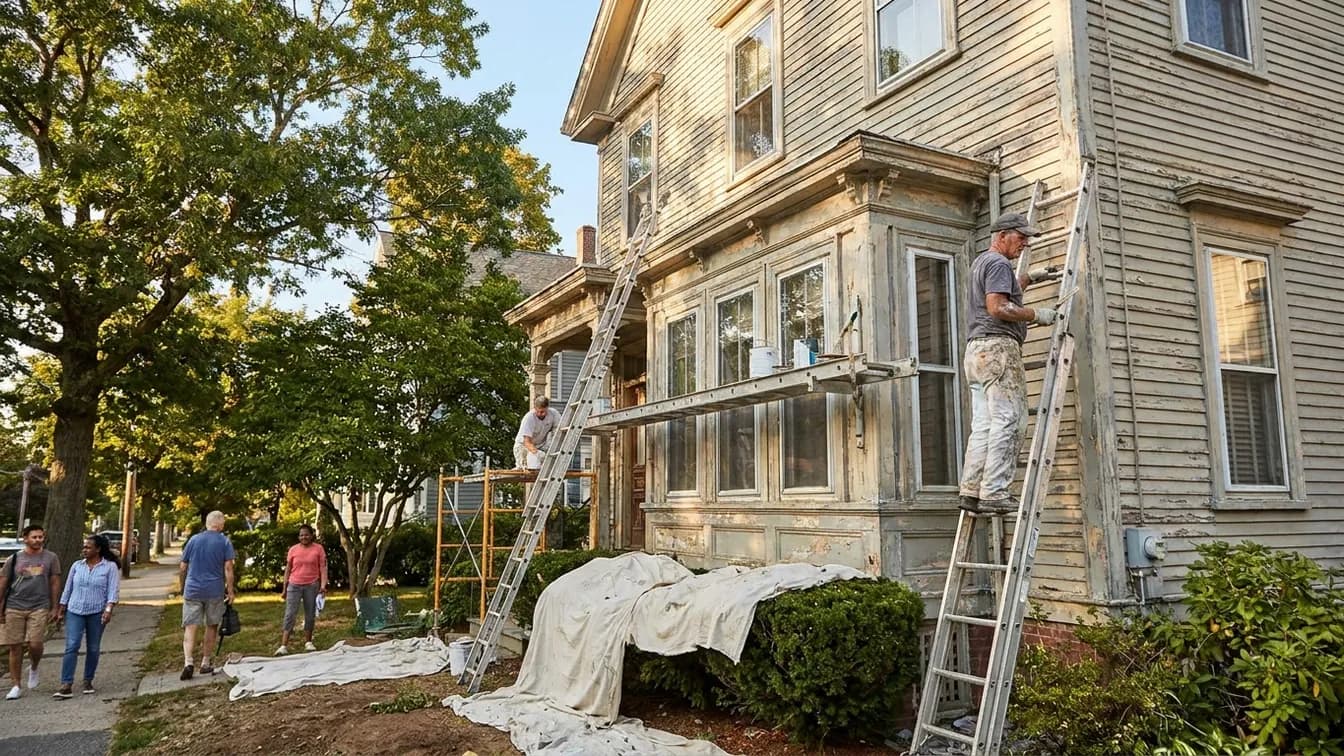
Buying a Massachusetts home built before 1978 puts state and federal lead paint rules straight into your purchase contract.
A 10-day inspection right, mandatory deleading rules for children under six, and lender standards for paint condition shape every pre-1978 purchase.
Check Your Massachusetts Home Purchase Eligibility
Know these rules to request the right records before signing the purchase and sale agreement and budget for any post-closing work.
What the Lead Law Means for Your Purchase
Massachusetts lead law has two separate parts for a home buyer. At the sale, the seller of a pre-1978 home must give you a state lead notification package and allow you at least 10 days to inspect for lead at your own expense.
After you own the home, deleading is triggered by a child under six living there, not by the sale. When a child under six lives in the home, you must remove, cover, or place under interim control any lead paint hazards, and that rule applies to every owner, including people in their own single-family home, not just landlords.
Lead hazards are not limited to peeling walls; state rules include loose lead paint, lead paint on windows and other friction or impact surfaces, and lead paint on surfaces children can reach. Homes built before 1978 may contain lead paint, and only a test by a licensed lead inspector tells you what a specific house has.
At transfer, the state notification package is designed to satisfy both state and federal disclosure rules at once.
What the Seller Must Give You Before You Sign
Before you sign a binding purchase and sale agreement, a lease with an option to purchase, or a memorandum of agreement in a foreclosure sale on a pre-1978 home, the seller and the real estate agents involved must complete four steps with you.
- Provide the Property Transfer Lead Paint Notification: Give you the official state notification packet, which was revised in 2026 to include expanded information on health effects, blood lead testing, hazards, prevention, and deleading.
- Disclose known lead information and records: Tell you anything they know about lead in the home and give you copies of any existing lead inspection reports, risk assessment reports, Letters of Compliance, or Letters of Interim Control.
- Explain the 90-day rule: Inform you that when a child under six will live in the home, the owner must have it deleaded or placed under interim control within 90 days of taking title.
- Sign the certification checklist: Sign, and have you sign, the certification page confirming you were notified of the Lead Law requirements.
A seller who skips the transfer notification is liable for all damages caused by the violation and faces a civil penalty of up to $1,000 under Massachusetts law. Violations by real estate professionals or commercial sellers count as unfair or deceptive acts under the state's consumer protection law, and federal law adds civil and criminal penalties.
Check a Home's Lead History Before You Offer
You do not have to wait for the seller's packet to see if a house has ever been tested. The Lead Safe Homes lookup on mass.gov, run by the Department of Public Health's Childhood Lead Poisoning Prevention Program (CLPPP), shows whether a pre-1978 home has been inspected and whether compliance paperwork exists so you can ask the seller for copies.
If you have questions about a specific property record, you can call CLPPP at (800) 532-9571.
Your 10-Day Lead Inspection Window
Massachusetts law requires the seller of a pre-1978 home to give you at least 10 days, or a longer period if you both agree, to have a lead inspection or risk assessment done, typically through a contingency in the purchase and sale agreement.
- Optional: You are not required to inspect a home for lead before buying it, though the Department of Public Health recommends doing so.
- You pay: A standard lead inspection runs roughly $250 to $700 nationally, with larger single-family and multifamily homes costing more, so request direct quotes from licensed Massachusetts inspectors.
- You can waive it: You can waive the inspection even in a competitive market, but the seller must still give you the Property Transfer Lead Paint Notification and you must still sign the certification checklist.
- Foreclosure sales: Foreclosure sales are an exception to the 10-day inspection period, though the notification itself is still required before you sign a foreclosure memorandum of agreement.
Plan for the inspection fee alongside your other contract-period expenses in Massachusetts closing costs and, if the house has a private septic system, coordinate the timing with Title 5 septic inspections.
Check Your Massachusetts Home Purchase Eligibility
Do You Have to Delead After You Buy?
You only have to delead after buying a pre-1978 Massachusetts home if a child under six lives there.
| Situation | Deleading required? | Deadline |
|---|---|---|
| No child under 6 lives there (owner-occupied or rental) | No | None unless a child under 6 moves in later |
| A child under 6 will live there at move-in (yours, a relative's, or a tenant's) | Yes: full compliance or interim control | Within 90 days after taking title |
| A child under 6 is born or moves in later | Yes | When the child lives there |
| The home already has a valid Letter of Full Compliance | Generally no | Get a copy from the seller and keep surfaces maintained |
Buyers with no young children can live in an older home without deleading, while planning ahead if they expect a baby or a young relative to move in later. With a child under six at move-in, book your licensed inspector or risk assessor right away so the 90-day clock does not run out.
Full Compliance or Interim Control
When you need to bring a home into compliance under the Lead Law, Massachusetts gives you two options: permanent full compliance or temporary interim control.
| Feature | Full compliance | Interim control |
|---|---|---|
| What it does | Permanently removes or covers required lead paint hazards | Fixes urgent hazards and controls the rest while you plan full deleading |
| Who inspects first | Licensed lead inspector | Licensed risk assessor |
| How long it lasts | Not time-limited; keep surfaces maintained | 1 year, renewable once (2 years total) |
| State tax credit | Lesser of cost or $3,000 per unit | Lesser of half the cost or $1,000 per unit |
Who Can Do the Work
Deleading is regulated work, licensed by the Massachusetts Department of Labor Standards.
- Some deleading work can only be done by a licensed deleader.
- A property owner or the owner's agent may perform certain low- and moderate-risk deleading tasks, but only after a licensed lead inspector has inspected the home and the owner or agent has completed required state training and received official authorization.
- When the work is finished, a licensed lead inspector reinspects for a Letter of Full Compliance, or a licensed risk assessor approves the work for a Letter of Interim Control.
What Deleading Costs and How to Pay for It
There is no single statewide average cost for deleading because the price depends on the size of the home, the number of windows, the number of units, and the hazards found. If your 10-day inspection turns up lead hazards, get itemized quotes from licensed deleading contractors before your inspection contingency expires.
To help owners and small landlords cover the bill, Massachusetts offers both a state income tax credit and subsidized loans; because tax rules and program limits can change, confirm current published figures with the Department of Revenue or MassHousing when you apply or file.
The Lead Paint Tax Credit
Owners who pay to bring a Massachusetts residential unit into compliance can claim a state income tax credit on Schedule LP.
- Full compliance earns a credit equal to the lesser of the actual cost of deleading or $3,000 per deleaded residential unit.
- Interim control earns a credit equal to the lesser of 50% of the actual cost or $1,000 per unit.
- Unused credit larger than your Massachusetts income tax for the year carries forward for up to seven tax years.
- The property does not have to be your principal residence, so non-residents who own Massachusetts residential property can claim the credit against their Massachusetts tax liability, and condominium owners can claim it for qualifying work on condo common areas.
- The work must follow the state compliance process and result in a Letter of Full Compliance or a Letter of Interim Control issued by a licensed inspector or risk assessor.
For example, fully deleading all three units of a three-family home where each unit costs at least $3,000 earns a state tax credit of up to $9,000 ($3,000 for each of the three units). Any credit you cannot use in the first year carries forward for up to seven tax years.
MassHousing Get the Lead Out Loans
MassHousing's Get the Lead Out program provides low- and no-interest financing for lead paint removal in 1- to 4-family homes, including condominiums.
- Loan amounts: Maximum loans range from $30,000 to $45,000 depending on whether the property is a single-family or multifamily home.
- Repayment for owner-occupants: Loans for owner-occupants are deferred with no monthly payments required, and low- and no-interest options are available depending on the borrower.
- Upfront costs: No property appraisal is required, and MassHousing pays the closing costs and fees for owner-occupied homes.
- Relocation funds: Funds are available to help cover temporary relocation while deleading work takes place.
- Completion deadline: Projects financed through the program must be completed within six months of loan closing.
- Eligible borrowers: Income-eligible owner-occupants, investor-owners who rent to income-eligible tenants, and nonprofit organizations can apply, subject to county income limits.
Get the Lead Out is separate from your purchase mortgage, and you apply through a participating Local Rehabilitation Agency listed by MassHousing.
Check Your Massachusetts Home Purchase Eligibility
Extra Rules If You Buy a Multifamily or Rental
If you are buying a two-, three-, or four-family home with one of the multifamily mortgages in Massachusetts, you need to build lead compliance into your purchase budget and rental cash-flow plan from day one.
Strict Liability
In Massachusetts, property owners are held strictly liable if a child is poisoned by lead hazards in their building, a rule confirmed by the Supreme Judicial Court in 1987. The injured child's family does not need to prove the owner was negligent, and having a tenant sign a lease waiver does not protect the landlord or avoid liability.
Holding a valid Letter of Full Deleading Compliance or an active Letter of Interim Control shields you from strict liability claims, though you must still exercise reasonable care.
You Cannot Turn Away Families With Young Children
Because deleading a rental unit costs money, some new landlords wonder whether they can rent only to households without young children. Under Massachusetts law, it is illegal discrimination to refuse to rent to, or to evict, families with children under six because a unit contains lead paint or needs to be deleaded.
If an applicant with a child under six qualifies for your unit, you must rent to them on the same terms as anyone else and pay to bring the unit into compliance.
How Lead Paint Affects Your Mortgage
Lead Law compliance is not a general condition for getting a mortgage, so a missing Letter of Compliance alone is not a standard reason a lender declines a loan. What can affect your mortgage approval is the physical condition of the paint, depending on the loan program you use.
FHA Loans and Peeling Paint
For a pre-1978 single-family or 2- to 4-unit home financed with an FHA loan, federal appraisal rules treat paint that is cracking, scaling, chipping, peeling, or loose as a defective paint surface. When the appraisal notes defective paint, it generally must be corrected before closing unless a certified lead inspector finds it is not lead-based.
Ask the seller early who will handle any paint repairs the appraisal calls for, and review the full property standards in our guide to FHA loans in Massachusetts.
When the Home Needs More Work
If the seller refuses to fix peeling paint or worn wood windows before closing, a standard mortgage can stall at the appraisal stage. Renovation financing such as FHA 203(k) renovation loans or a conventional renovation loan lets eligible buyers finance the purchase and licensed repairs and lead hazard abatement in one loan that closes before work begins.
As a mortgage broker comparing options across multiple wholesale lenders, Make Massachusetts Your Home (operated by Next Wave Mortgage, LLC) helps you look at the property's condition upfront and choose a conventional, FHA, VA, or renovation loan that fits the home you are buying.
Next Steps
Before you make an offer on a pre-1978 home, put the disclosure, inspection, and loan steps in order.
- Before you sign the purchase and sale agreement, read the 2026 Property Transfer Lead Paint Notification, check the Lead Safe Homes lookup on mass.gov for prior inspection records, and decide whether to use your 10-day inspection window.
- Walk the interior and exterior for peeling, chipping, or cracking paint, especially if you are using an FHA loan, so you can address paint repairs during offer negotiations.
- If a child under six will live in the home or in a rental unit you are buying, book a licensed lead inspector or risk assessor right away to meet the 90-day window and keep your compliance letters to claim the Schedule LP tax credit.
Checking your purchase eligibility with our team takes no hard credit pull, and once your documents are in, a full pre-approval typically takes 1 to 3 business days. You can also schedule a free 15-minute call with a loan officer to talk through your plans.
Ready to Get Started?
Check your eligibility in under 2 minutes. No credit pull, no obligation.
Get our Massachusetts updates in your Google feed
Add Make Massachusetts Your Home as a preferred source to see our rate, grant, and program updates more often in Google Search.