

Much of the advice online about DACA home loans is out of date, because FHA closed its door to non-permanent residents in 2025.
Two loan paths still work for DACA recipients and ITIN tax filers in Massachusetts in 2026, while MassHousing, local programs, and private ITIN mortgages follow separate rules.
Check Your Alternative Mortgage Eligibility
You can match your identification and tax documents to the right loan channel and know what to prepare before talking with a loan officer.
Can DACA Recipients Buy a House in Massachusetts?
Yes. Nothing in Massachusetts state law stops a DACA recipient or an Individual Taxpayer Identification Number (ITIN) holder from buying and holding title to a home. Our guide on whether foreigners can buy property in Massachusetts explains how property ownership rules work for non-citizens across the state.
The real question is the mortgage, because each loan backer sets its own residency, work authorization, and tax ID rules.
- DACA recipients: Typically hold a valid Employment Authorization Document (EAD, category C33) and a Social Security number (SSN), though DACA itself is not lawful permanent residency.
- ITIN borrowers: File federal income taxes with an IRS-issued nine-digit Individual Taxpayer Identification Number because they are not eligible for an SSN.
Having an SSN and work authorization is what separates the two mortgage paths in 2026.
| Loan | DACA (valid EAD and SSN) | ITIN only (no SSN) |
|---|---|---|
| Fannie Mae conventional | Yes, with many lenders | No |
| Freddie Mac conventional | No | No |
| FHA | No (since May 25, 2025) | No |
| MassHousing loans and down payment help | Conventional path only; confirm with lender | No |
| ONE Mortgage and city programs | Ask before applying | Ask before applying |
| Private ITIN or portfolio loan | Varies by lender | Yes |
FHA Loans Are Closed to DACA Recipients
DACA recipients cannot get an FHA loan for any FHA case number assigned on or after May 25, 2025.
On March 26, 2025, the U.S. Department of Housing and Urban Development (HUD) removed the non-permanent resident rules from the FHA rulebook in their entirety, ending eligibility for all non-permanent resident borrowers. FHA's stance on DACA had changed several times over the years before this change.
- Who can still use FHA: U.S. citizens, lawful permanent residents (green card holders), and citizens of the Federated States of Micronesia, the Republic of the Marshall Islands, and Palau.
- Reverse mortgages too: The rule covers standard FHA purchase and refinance loans as well as FHA Home Equity Conversion Mortgages (HECM).
- Existing FHA borrowers: Non-permanent residents who already hold an FHA mortgage cannot do future FHA transactions, including FHA streamline refinances.
FHA lending to non-permanent residents has since fallen to nearly zero, so older advice to apply for an FHA loan no longer works; the paths now are Fannie Mae conventional loans or private loans.
Check Your Alternative Mortgage Eligibility
Conventional Loans: Fannie Mae Yes, Freddie Mac No
Most conventional loans in Massachusetts follow the rules of Fannie Mae or Freddie Mac, the two government-sponsored enterprises (GSEs) that buy mortgages from lenders, and the two treat DACA status differently.
How Fannie Mae Treats DACA Borrowers
Fannie Mae buys mortgages made to non-U.S. citizens who are lawful permanent or non-permanent residents on the same terms available to U.S. citizens. It leaves the lender to determine status case by case and to warrant that the borrower is legally present in the United States.
In practice, lenders can treat DACA recipients with a valid EAD (category C33) and SSN as lawfully present non-permanent residents, and many do. Some lenders add stricter in-house rules—called lender overlays—on top of Fannie Mae's guide, so confirm the lender's policy up front.
Why Freddie Mac Loans Don't Work
Lender guides state that Freddie Mac does not accept DACA status, so a DACA borrower's conventional loan must be one that can be sold to Fannie Mae or kept in the lender's own portfolio.
Working with a mortgage broker that compares multiple wholesale lenders makes it easier to route your application to lenders that follow Fannie Mae's DACA guidance without restrictive overlays.
Keep Your EAD Current
U.S. Citizenship and Immigration Services (USCIS) continues to accept DACA renewal applications for existing recipients in 2026, while initial applications remain restricted and litigation over the program continues. If you plan to apply for a mortgage with DACA documents, renew your EAD well ahead of its expiration date and check USCIS directly for updates.
VA and USDA Loans
VA home loans require eligible U.S. military service and are rarely relevant for DACA or ITIN buyers. Current USDA rural development rules for DACA recipients could not be confirmed, so ask the lender to verify USDA residency guidelines if you are shopping in a USDA-eligible Massachusetts town.
Can You Use MassHousing, ONE Mortgage or City Programs?
ITIN-only buyers cannot use MassHousing, while DACA buyers with an SSN can only qualify through a conventional path. Non-citizen rules for ONE Mortgage and city grants are not spelled out in the materials we reviewed, so confirm before applying for Massachusetts first-time homebuyer programs.
MassHousing
MassHousing follows conventional (GSE) and FHA rules on non-citizen eligibility, and the originating lender must warrant that the borrower is legally present in the United States. MassHousing lists foreign nationals, borrowers without an SSN, and borrowers who are not lawful U.S. residents as ineligible.
- ITIN-only borrowers cannot use a MassHousing mortgage because they do not have a Social Security number.
- That also rules out MassHousing down payment assistance (up to $30,000; confirm current limits with a participating lender), because the assistance must be paired with a MassHousing first mortgage.
- DACA borrowers with an SSN cannot use MassHousing FHA loans for case numbers assigned on or after May 25, 2025, and must qualify through a conventional (Fannie Mae) MassHousing path that both the participating lender and MassHousing accept.
Next Wave Mortgage is not a participating MassHousing lender; buyers apply for MassHousing loans through a MassHousing-approved lender, and our team helps buyers check eligibility, compare loan options across wholesale lenders, and get pre-approved.
ONE Mortgage and City Programs
- ONE Mortgage (MHP): Non-citizen rules are not spelled out in the materials we reviewed. Call MHP at 1-800-752-7131 or ask a participating ONE Mortgage lender whether your status qualifies.
- Boston and other city programs: Boston has a U.S. residency verification policy for its housing programs, but we could not confirm current rules for DACA. Ask the city housing office or a participating lender first.
Check Your Alternative Mortgage Eligibility
How ITIN Mortgages Work
If you file taxes with an ITIN instead of an SSN, agency loans (FHA, Fannie Mae, Freddie Mac, and MassHousing) will not fit. An ITIN mortgage is a private non-agency loan—often called a non-QM or portfolio loan—from a wholesale lender, bank, or credit union, and each lender writes its own rules.
ITIN loans typically require larger down payments than agency loans and carry higher interest rates and closing costs. Because each private lender prices risk differently and mortgage rates change daily, no single down payment percentage or rate applies to every borrower.
Many retail banks do not offer an ITIN loan at all. As a mortgage broker, our team compares non-QM loan options across multiple wholesale lenders to find programs that accept ITIN documentation.
If you live outside the United States and are buying a vacation or investment property without U.S. tax residency, that falls under a foreign national loan rather than a resident ITIN loan.
Keep Your ITIN Active
An ITIN is a federal tax processing number issued by the IRS to people who need a U.S. taxpayer number but are not eligible for an SSN. It is for federal tax reporting only and does not authorize work in the United States.
Check your filing history before applying, because an ITIN expires if it isn't used on a federal tax return at least once in three consecutive tax years. File your federal returns on time every year, and locate your official IRS ITIN assignment or renewal letter before starting a loan application.
Documents ITIN Lenders Usually Ask For
- IRS ITIN letter showing your active Individual Taxpayer Identification Number
- Filed federal tax returns (commonly the most recent two years) with W-2s, 1099s, or business schedules
- Proof of current income, such as recent pay stubs or, if self-employed, bank statements
- Bank statements showing funds for your down payment, closing costs, and cash reserves
- Government-issued photo ID, such as a valid foreign passport, consular ID card (matrícula consular), or state driver's license
- Rent payment history (canceled checks or bank transfers) and, if you do not have a traditional credit score, records of on-time payments for utilities, auto insurance, or cell phone bills
Exact document checklists vary from one wholesale lender to the next.
How to Prepare Before You Apply
Alongside residency and tax-filing rules, you will also need to meet standard income, credit, and asset benchmarks; see our guide to the requirements to buy a house in Massachusetts for the full baseline.
A Massachusetts License Is ID, Not Lawful Presence
Since July 1, 2023, the Massachusetts Work and Family Mobility Act has allowed eligible residents to get a standard Class D or Class M driver's license through the Registry of Motor Vehicles (RMV) regardless of immigration status, using identity documents such as a valid foreign passport or consular ID.
A Massachusetts driver's license is useful as clean, state-issued photo identification for your loan file and closing table, but it does not establish lawful presence for a mortgage. A DACA borrower on a Fannie Mae loan still needs a valid EAD and SSN, and an ITIN borrower still uses a private non-QM ITIN loan.
Consider a Two-Family Home
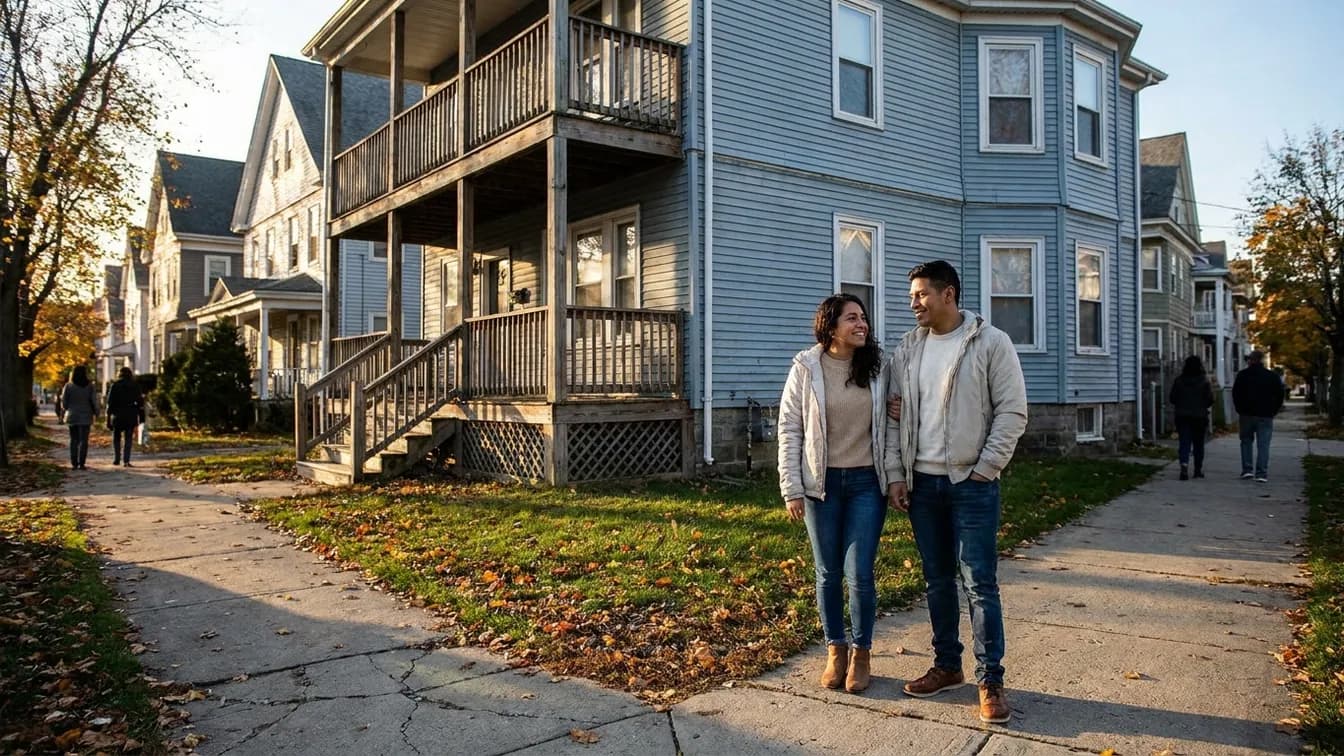
Living in one unit of a two-family home and renting out the other is a common way to offset your monthly payment. With a Fannie Mae conventional loan or a non-QM program that allows 2-unit homes, part of the projected rent from the second unit may help you qualify.
Multi-unit purchases often require higher down payments and cash reserves than single-family homes. Read our guide to multifamily mortgages in Massachusetts for how lenders calculate rental income.
Build a Credit Track Record
- Open a secured credit card that reports to the major credit bureaus if your credit file is thin, and keep the balance low.
- Pay rent by check, money order, or electronic bank transfer rather than cash so you have a clear paper trail of on-time housing payments.
- Avoid depositing large sums of unverified cash into your bank accounts before applying, because lenders must verify the source of down payment funds through clean bank statements.
Take a CHAPA Homebuyer Class
First-time homebuyer education classes approved by the Citizens' Housing and Planning Association (CHAPA) are open to anyone in Massachusetts. Even if your loan does not require a certificate, a class is an inexpensive way to learn how Massachusetts purchase and sale agreements, home inspections, property taxes, and closing attorneys work.
Know Your Fair Lending Rights
Federal fair lending law prohibits mortgage lenders from discriminating against any applicant based on national origin. At the same time, the law allows a lender to consider immigration status or permanent residency and related information needed to understand the lender's rights and remedies regarding repayment.
In plain terms, a lender cannot treat you unfairly because of where you or your family come from, and they should give you a clear, respectful explanation of which loan programs fit your documents.
Next Steps
Because FHA is closed to non-permanent residents and each lender sets its own Fannie Mae DACA overlays and private ITIN rules, have your documents reviewed before you start touring homes.
Starting an eligibility check or pre-approval with our team takes no hard credit pull. Once your documents are in, pre-approval typically takes 1 to 3 business days, and purchase closings typically take 30 to 45 days.
You can also schedule a free 15-minute call with a loan officer to review your EAD or ITIN documents and compare wholesale lenders.
Ready to Get Started?
Check your eligibility in under 2 minutes. No credit pull, no obligation.
Get our Massachusetts updates in your Google feed
Add Make Massachusetts Your Home as a preferred source to see our rate, grant, and program updates more often in Google Search.