DSCR Cash-Out Refinance in Massachusetts
You have built equity in your Massachusetts rental property — now put that capital to use. A DSCR cash-out refinance lets you pull cash from a non-owner-occupied investment property based on its rental income, not your personal tax returns. Use the proceeds for your next two- or three-family purchase, deleading and property renovations, or to pay off a short-term rehab loan.


DSCR Cash-Out Refinance at a Glance
A DSCR (Debt Service Coverage Ratio) cash-out refinance replaces your current mortgage on a Massachusetts rental property with a larger loan and pays you the remaining proceeds at closing. Instead of checking your personal debt-to-income ratio, the lender evaluates whether the property's rent covers the new principal, interest, property taxes, insurance, and any association dues (PITIA).
| Feature | How It Works |
|---|---|
| Qualifying Income | Current lease agreement or appraiser's market rent schedule, generally without personal tax returns or W-2s (varies by lender) |
| Eligible Property Usage | Non-owner-occupied investment and rental properties only (never a principal residence) |
| Maximum Loan-to-Value (LTV) | Determined by each non-QM lender's guidelines according to credit score, DSCR ratio, and property type |
| Ownership Seasoning | Depends on the lender's program before the new appraised value can be used in place of the original purchase price |
| DSCR Calculation | Gross monthly rent divided by the new, larger monthly PITIA payment |
| Rental Income Sources | Long-term lease agreement, appraiser's market rent estimate, or qualifying short-term rental revenue |
| Vesting Options | Personal name or an approved business entity like an LLC, based on lender guidelines |
Owner-Occupied Principal Residence vs. Massachusetts Rental (DSCR)
Many state and federal consumer protections are built specifically for a borrower's principal residence, while a non-owner-occupied rental refinance is a business-purpose transaction governed by the lender's investment-property guidelines.
| Rule or Factor | Owner-Occupied Principal Residence | Massachusetts Rental Property (DSCR) |
|---|---|---|
| Federal Regulation Z (12 CFR 1026.3(a)) | Covered by Truth in Lending consumer-credit rules, including consumer refinance disclosures and rules | Exempt as credit primarily for a business or commercial purpose (and credit to a non-natural person such as an LLC); consumer-loan rules like TILA generally don't apply |
| MA Predatory Home Loan Practices Act (MGL c. 183C) | Covers high-cost home mortgage loans defined as consumer credit transactions secured by the borrower's principal dwelling | A business-purpose loan on a non-owner-occupied rental is not a consumer loan secured by the borrower's principal dwelling |
| Massachusetts Homestead Act (MGL c. 188) | Protects an owner's principal residence (including an automatic $125,000 homestead protection) | Does not apply because a non-owner-occupied rental is not your principal residence |
| Cash-Out LTV & Seasoning Limits | Set by agency or consumer mortgage program rules for primary residences | Maximum LTV, DSCR minimum, and seasoning are set by each wholesale lender's investment-property guidelines |
| Local Property Tax Residential Exemption (MGL c. 59 s. 5C) | Eligible in cities and towns that adopt it (up to 35% of average assessed residential value, such as $4,353.74 in Boston for FY2026) | Not eligible; non-owner-occupied rentals pay the full residential tax bill without the principal-residence exemption |
How Massachusetts Landlords Use the Cash
Buy the Next Two- or Three-Family
Put equity from an existing single-family or triple-decker toward the down payment and closing costs on your next Massachusetts rental.
Pay Off Short-Term or Rehab Loans
Bought and renovated a property with short-term bridge or rehab financing? Replace it with a long-term DSCR mortgage based on the property's rent.
Fund Deleading & Renovations
Under MGL c. 111 s. 197, owners must abate or contain dangerous lead where a child under six resides. Cash-out funds can cover deleading, energy upgrades, or kitchen and bath remodels.
Build Portfolio Reserves
Keep liquidity on hand for municipal property taxes, capital repairs, and unit turnovers without selling a performing Massachusetts asset.
Cash-Out vs. Rate-and-Term
Refinancing a rental property does not always mean taking cash out. When you only want to pay off your current loan without pulling extra cash at closing, a rate-and-term DSCR refinance follows different rules.
| Feature | DSCR Cash-Out Refinance | DSCR Rate-and-Term Refinance |
|---|---|---|
| Main Goal | Retire the current mortgage and take out home equity as cash at closing | Retire the current mortgage to adjust the rate or loan term without taking additional cash |
| Maximum LTV | Capped by the specific lender's cash-out LTV limits | Capped by the specific lender's rate-and-term LTV limits |
| DSCR Impact | A higher loan amount raises the monthly payment that rental income has to support | A lower loan amount holds down the monthly payment, making the required DSCR easier to reach |
| Best For | Acquiring another rental, funding deleading or rehab, or replenishing reserves | Paying off a loan near maturity or securing better terms without pulling out cash |
Massachusetts Cost & Tax Realities
Massachusetts charges a 5% personal income tax on most income (plus a 4% surtax on taxable income above $1,107,750 for tax year 2026), and rental income is taxable in the Commonwealth. Because DSCR underwriting uses the property's gross rent rather than your personal tax returns, write-offs on Schedule E do not reduce your qualifying income—but local closing costs, property taxes, and short-term rental rules directly affect your numbers.
| Massachusetts Factor | What It Means for Your Cash-Out Refinance |
|---|---|
| No Deed Excise on a Refinance (MGL c. 64D s. 1) | The Massachusetts deed excise ($4.56 per $1,000 statewide; $6.48 per $1,000 in Barnstable County) applies to deeds conveying property, not to mortgages given only to secure a debt. If you transfer title into an LLC as part of the transaction, ask your attorney whether any deed excise applies. |
| Registry Recording Fees | While no deed excise applies to a mortgage, you do pay Registry of Deeds recording fees. For example, the Plymouth County Registry of Deeds fee schedule (effective January 1, 2024) lists $205 to record a mortgage and $80 for a municipal lien certificate; confirm current fees with your county registry. |
| Property Taxes Without the Residential Exemption | Massachusetts cities and towns set property tax rates per $1,000 of assessed value (fiscal year July 1 to June 30). In communities that adopt the local-option residential exemption (MGL c. 59 s. 5C), non-owner-occupied rentals do not receive it. In Boston for FY2026, the residential rate is $12.40 per $1,000 (plus a Community Preservation Act surcharge), and the $4,353.74 residential exemption goes only to owner-occupants. |
| Lead Law Compliance (MGL c. 111 s. 197) | In older Massachusetts housing stock, if a child under six resides in a unit with dangerous levels of lead in paint, plaster, or other accessible structural material, the owner must abate or contain it through interim control or full compliance. Many landlords use cash-out proceeds to pay for deleading. |
| Short-Term Rental Excises & Local Rules (MGL c. 64G) | Stays of 31 consecutive calendar days or less owe the 5.7% state room occupancy excise (when rent is $15+/day unless the registered 14-day rule applies), plus local option excise up to 6% (up to 6.5% in Boston), a community impact fee up to 3%, and 2.75% in Cape Cod and Islands Water Protection Fund towns. Operators must also carry at least $1,000,000 in liability coverage (MGL c. 175 s. 4F(b)). Note that Boston licenses STRs only in owner-occupied properties, so non-owner-occupied Boston DSCR loans generally rely on long-term rents. |
See How Much Equity Your Massachusetts Rental Can Support
Tell us your property's approximate value, existing mortgage balance, and monthly rental income. Our team will compare DSCR cash-out refinance options across wholesale lenders and check whether the rental income covers the new payment.
Check Your DSCR Cash-Out EligibilityHow a Massachusetts DSCR Cash-Out Refinance Works
- 1
Review Property Cash Flow & Equity
Tell us your Massachusetts rental's estimated market value, current loan payoff, monthly rent, and city or town property tax bill so we can model the new PITIA payment.
- 2
Gather Property Documents
Provide your current leases (or STR payout history), mortgage statement, property insurance declarations, municipal tax bill, and LLC documents if vesting in an entity.
- 3
Order Appraisal & Rent Schedule
A licensed appraiser establishes the property's current market value and prepares a comparable rent schedule. That value, along with the lender's LTV and seasoning guidelines, helps set your maximum loan size, and the rent is used for the DSCR calculation.
- 4
Close & Receive Cash Proceeds
At closing, your existing lien is paid off, the new mortgage is recorded at the county Registry of Deeds, and your net cash proceeds are disbursed.
Related Massachusetts Guides

DSCR investor loans
How DSCR loans work in Massachusetts, qualifying on rental cash flow, and comparing wholesale lender options.
Read Guide
Short-term rental DSCR loans
Financing short-term rentals in Massachusetts, including state and local room occupancy excises and municipal rules.
Read Guide
Massachusetts Property Tax Rates by Town
How Massachusetts cities and towns set residential tax rates and how the residential exemption affects rental properties.
Read Guide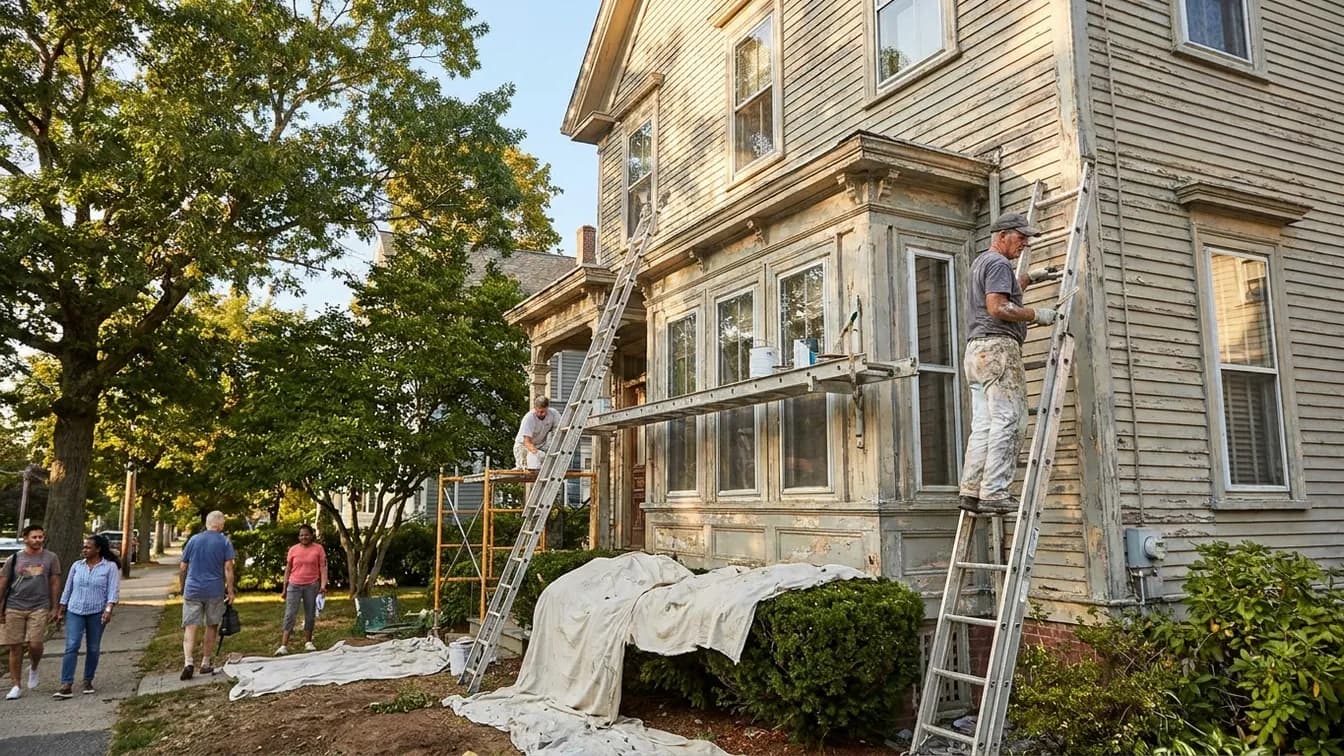
Massachusetts Lead Paint Law
What MGL Chapter 111, Section 197 requires for Massachusetts rental owners when a child under six lives in the property.
Read GuideFrequently Asked Questions
Straightforward replies to the common questions we hear from Massachusetts homebuyers. Can’t find what you’re looking for?
Talk to an ExpertThe limits come from the lender. Because a DSCR loan is a business-purpose mortgage on a non-owner-occupied rental, the maximum LTV, minimum DSCR ratio, credit score, and ownership seasoning requirements are set by each wholesale lender's program guidelines.
Generally no. The Massachusetts Predatory Home Loan Practices Act (MGL c. 183C) applies to consumer credit transactions secured by the borrower's principal dwelling, and the Massachusetts Homestead Act (MGL c. 188) protects an owner's principal residence. At the federal level, Regulation Z (12 CFR 1026.3(a)) exempts credit extended primarily for a business or commercial purpose and credit to non-natural persons such as an LLC, so consumer-loan rules like TILA generally don't apply to a non-owner-occupied rental refinance.
Instead of verifying your personal income with W-2s or federal and state tax returns, the lender calculates the property's Debt Service Coverage Ratio (DSCR). The gross monthly rent from the lease or appraiser's rent schedule is divided by the new monthly mortgage payment, including principal, interest, Massachusetts municipal property taxes, insurance, and any condo or HOA dues (PITIA). As long as the ratio meets the lender's guideline, the property's rental income qualifies the file.
No. Under MGL Chapter 64D, Section 1, the Massachusetts deed excise ($4.56 per $1,000 of consideration statewide, or $6.48 per $1,000 in Barnstable County) applies to deeds conveying property and does not apply to a mortgage given only to secure a debt. You will still pay Registry of Deeds recording fees—for example, $205 to record a mortgage under the Plymouth County Registry fee schedule—and if you transfer title into an LLC, you should ask your closing attorney whether any deed excise applies.
Under MGL Chapter 59, Section 5C, a city or town may adopt a residential exemption of up to 35% of the average assessed value of residential parcels, but it applies only to a taxpayer's principal residence. In a community that adopts it—such as Boston, where the FY2026 residential rate is $12.40 per $1,000 and the residential exemption saves owner-occupants $4,353.74—a non-owner-occupied rental does not receive the exemption, which increases the monthly tax escrow used in your DSCR calculation.
Yes. Many landlords pull equity from a single-family, two-family, or three-family rental to pay off short-term rehab financing, upgrade units, or pay for lead abatement or containment under the Massachusetts Lead Law (MGL c. 111 s. 197), which applies when a child under six resides in premises with dangerous levels of lead. Check with your loan officer on how each lender treats ongoing work versus completed renovations.
See How Much Equity Your Massachusetts Rental Can Support
Tell us about your investment property and current loan — no tax returns or hard credit pull required to check your options.